Design Engineering: Inventiveness, Analysis, and Decision Making >
Programmed Introduction to Probability >
Thermodynamics 1: An Introduction to Energy >
Engineering Design and Design for Manufacturing >
Solving Math Problems – A Reference for Teachers >
Introduction to Probability and Bayes’ Rules: A Text Programmed for Self-Learning >
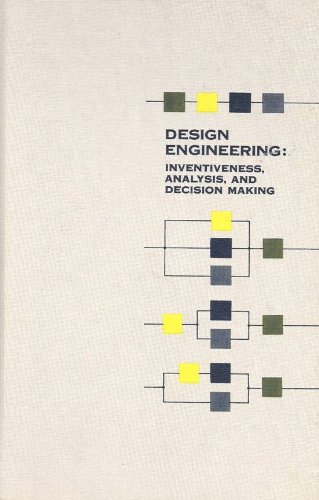
Design Engineering: Inventiveness, Analysis, and Decision Making – 1965
In 1962, a new Department Head at Purdue desperately wanted someone new to teach a new design course in a new curriculum. He took a chance and chose me, as if I had drawn the short straw. I knew little about design, and nothing about teaching design. But I knew I had no interest in teaching old traditional machine design so I invented Design Engineering: Inventiveness, Analysis, and Decision Making, and a whole new career opened up for me. The book has been translated into Spanish, was found deep in a library in Shanghai, and is still for sale on Amazon.
As I thought about the design process, I abstracted out three problem-solving processes: invention, analysis, and decision making. None of these were design, per se’, but all of them seemed to be required to support the process. So I taught these topics and called it “design engineering.” The course was well enough liked and respected that I taught it again at Purdue and then at Swarthmore College.
There are creativity principles and exercises for students, some good engineering analysis problems and solutions, and an introductory look at decision theory. There aren’t really any design problems – like ‘design a beam to support a thousand pound crane’, or ‘design a toaster’, or ‘design a process to extract carbon from power plant combustion’ – but I’d write pretty much the same book again. Except I’d call it Some Principles And Skills Of Solving Engineering Problems.
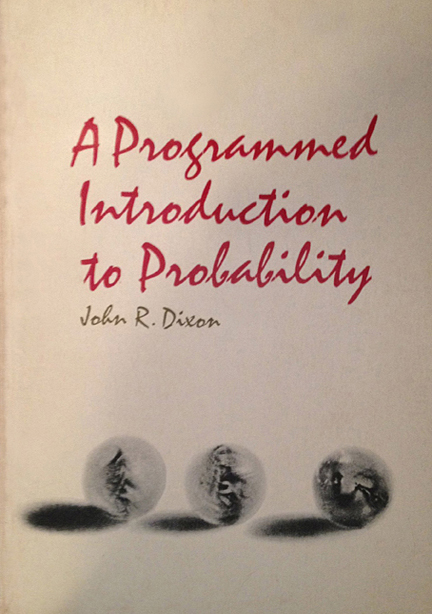
Programmed Introduction To Probability – 1964
This program, uniquely combining both linear and branched programming techniques, introduces the concept of probability, gives the rules of Bayesian probability and develops the facility for using the rules to solve problems. Such topics as decision theory, Boolean logic, and reliability are also introduced. The many exercises and example problems are selected to cover applications of probability to all fields of engineering. Neither set theory nor statistical techniques are discussed, nor is the calculus employed.
The programmed format allows the reader to progress at his own speed, to learn by doing, and to have his learning immediately reinforced. It also allows the book to be used in several ways – for independent self-study, as the sole textbook for a course, or as a supplemental textbook.
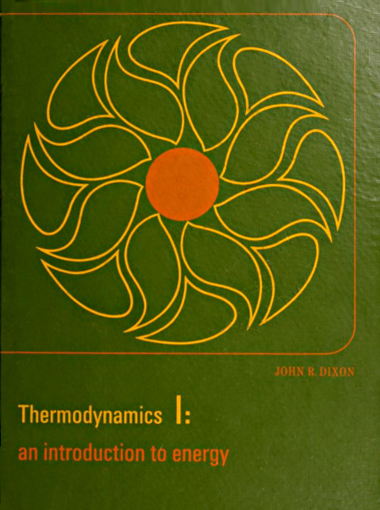
Thermodynamics 1: an Introduction To Energy – 1975
My first intellectual love was the science of thermodynamics. (Design was a second love.) I taught thermo first as a graduate student at M.I.T. and then everywhere else I went. The First and Second Laws of Thermodynamic are two of the most important scientific laws: Energy is Conserved and Entropy always increases.
Thermodynamics I was to be my statement on how the basics of the subject should be taught: as a science. It succeeded as a statement but failed commercially because of the many typos. (Don’t ask!) Maybe I’ll fix the errors and rewrite it someday.
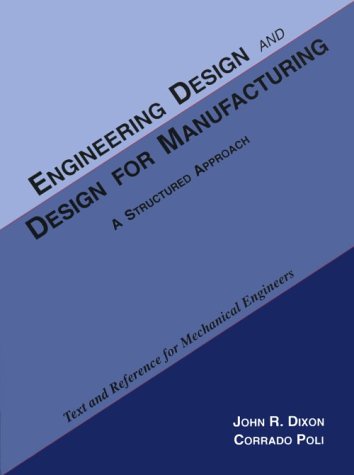
Engineering Design and DEsign For Manufacturing (with Corrado Poli) – 1999
In this book, engineering design is placed in context within the product realization process. Then it is treated in three interacting stages: conceptual, configuration, and parametric. At each stage, design problem solving is done by four steps of guided iteration: formulation of the problem, generation of alternatives, evaluation of alternatives, and redesign guided by the evaluations. Specific problem solving methods are presented for each step of guided iteration at each stage of the design process.
Design for manufacturing (DFM) is integrated throughout. It is included qualitatively in the form of specific guidelines for manufacturability, and quantitatively as analysis procedures for estimating tooling and processing costs. Chapters are included on manufacturing processes, and on selecting materials and processes.
The book concludes with chapters on communication, engineering economics, and legal and ethical issues related to design.

Solving Math Problems – A Reference for Teachers – 2008
This is a reference book for math educators in middle school, high school, and college. Over 200 solved problems are ready for classroom use. Solutions with the problems explain each problem-solving process clearly and completely. Easier problems are included for teaching the problem-solving process thoroughly before advancing to more difficult problems.
Problems are organized into five categories: pattern recognition, counting, word problems, optimization problems, and recreation problems. Word problems are solved by a single, generalized analysis process. There are Appendices on converting units, ‘per’ problems, constructing graphs, and triangles.
I think this is the best, most useful book I have written.
Limited copies are available. Contact the author >

Introduction to Probability and Bayes’ Rules: A Text Programmed for Self-Learning – 2020
This book starts with easy probability rules for single events, combined events A and B, combined event A or B, and proceeds to Bayes’ Rule derived and used to solve problems.
It is a programmed text intended for self-learning. Learners answer a series of carefully designed and tested questions, getting almost all of the answers correct. Answers and solutions are presented after each question. Each chapter has review questions and exam questions, with answers.
Though this book covers much of the same material as the 1961 book on probability described above, the format is completely different, and the emphasis on Bayes’ Rule is much greater – and new.
Bayes’ Rule is fascinating. It is derived easily from probability rules, but has far-reaching implications. Basically, it explains how to change one’s mind about the probability of an event when given new information. But it solves many problem situations beyond that.
 John R. Dixon