There are millions of vaccine deniers; no doubt there are also millions of climate change deniers — probably many of the same people. This entry in Jack’s Journal explains my personal journey from climate change skeptic to believer. Perhaps it will help others make the same trip.
Until four or five years ago, I was a global warming and climate change agnostic. I thought that maybe the obvious warming and weather changes were due to natural variations, and that good old Mother Nature would soon, or at least eventually, take care of itself – and us. The people touting climate change sounded like a chorus, each singing the same song, but I didn’t see much data. Like a wise guy, I asked: “If you want to take the earth’s temperature, where do you put the thermometer?
But then the weather kept getting worse, the storms bigger and badder, the fires larger and longer, the droughts deeper and more widespread. There was even an unheard-of February tornado in my town, less than a mile from my house!
Most environmental scientists (the chorus) were saying “it’s global warming from greenhouse gases.” I had to find out what all these alarmed scientists were talking about. Mostly, since I am (well, was) an engineer, I needed to see some data.
There are two key questions I wanted properly researched answers to:
1. Is the global warming for real, or could it be a part of a cycle?
2. If it’s real, is it caused by human activity; for example, burning fossil fuels?
To answer the first question, the indicator I used was ocean temperature. Oceans cover two-thirds of the earth’s surface, provide the water and energy to the atmosphere for the weather, provide a habitat for multitudes of animals and plants, and, where there are no sharks, the oceans offer some fun places to swim.
So to meaningfully measure the ocean’s temperature, where do scientists put the thermometer? The answer is that they literally put thermometers in thousands of places; they measure often, and over a long period of time. Temperature measurements are collected systematically from ships, as well as at stationary and drifting buoys. Many people are involved. The data have been analyzed by and are available from the National Oceanic and Atmospheric Administration (NOAA), a very credible scientific organization. If you want, see https://icoads.noaa.gov/products.html.
The graph below, from NOAA, shows the average ocean surface temperature from 1880 to 2020. That’s over a century! Notice the upward trend since about 1910.
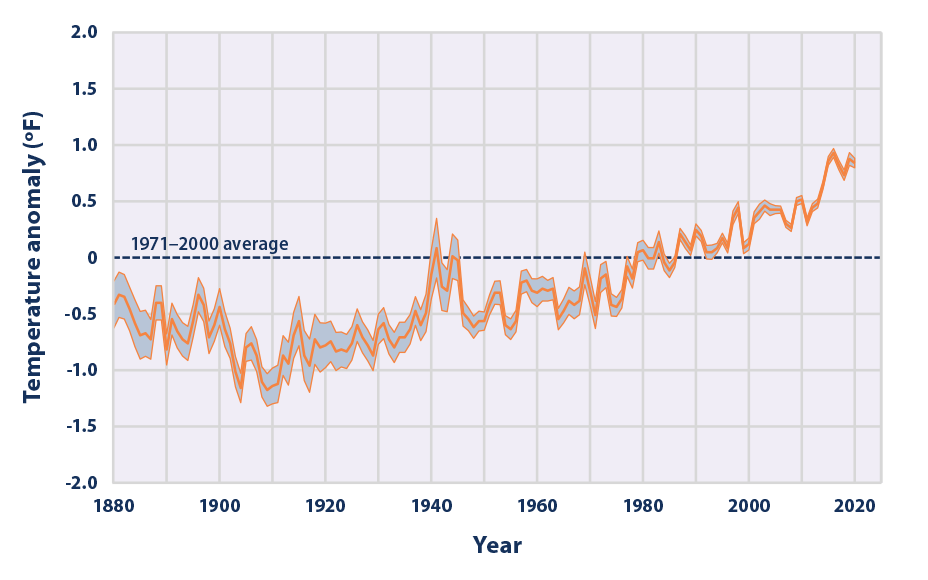
The little blip around 1940-45 is interesting. That has to have something to do with World War II – maybe it was harder to get data? Or there was more data from warmer locations?
I suppose this century-long trend could be part of a lengthy cycle to come, but I very much doubt it. No way to tell for sure, but the upward trend is way too long. My conclusion to a high degree of certainty is that the ocean temperature is in fact rising. About 0.15 degrees Fahrenheit every ten years; that’s 1.5 degrees every century.
The rising ocean temperature makes the recent dramatic weather reasonable. More water vapor and energy into the atmosphere means more weather activity – like tornadoes in Western Massachusetts in February.
Another indicator of rising earth temperature, not so scientific but maybe more convincing to some, is that wine growing is moving North. There are, for example, new vineyards in England growing grapes transplanted from France. English weather has always and forever before been too cold for grapes.
The Greenhouse Effect
The ‘greenhouse effect’ is simple and well understood as it applies to greenhouses. The essence is that very short wavelength radiation from the high temperature sun passes through the covering glass essentially unimpeded. But then the relatively long wavelength infrared radiation from the inner parts of the greenhouse is reflected by the glass back into the greenhouse. Thus energy from the sun does not get reradiated back to space; it is ‘trapped’ in the greenhouse.
The greenhouse effect for the earth is similar but more complex. The sun’s short wavelength radiation passes through the earth’s atmosphere almost unimpeded. However, the longer wavelength infrared reradiation from the earth back to space is absorbed (captured) by some of the gases in the atmosphere. These are the so-called ‘greenhouse gases’, some occurring naturally and some generated by burning fossil fuels: carbon dioxide, methane, nitrous oxide, and water vapor. These gases radiate about half the energy they capture out to space and about half back to earth. The more of these gases there are, the more they capture and reradiate back to earth.
There is quite a lot of research verifying that the greenhouse gases do in fact produce a greenhouse effect in proportion to their concentration in the atmosphere. By measuring the wavelengths of infrared radiation that reaches the surface, it has been shown that carbon dioxide, ozone, and methane are significantly contributing to rising global temperatures. There are publications from NASA, EPA, NOAA, the Royal Society, IPCC (Intergovernmental Panel on Climate Change) and other organizations as well as independent scientists. Most publications have been peer reviewed, and there are many documented references.
Similar data exists for methane and nitrous oxide
That the amount of these gases has been growing is hardly in doubt. I didn’t doubt it, but I still looked for some data. Here is a graph of the growth of carbon dioxide from 1960 to 2020:
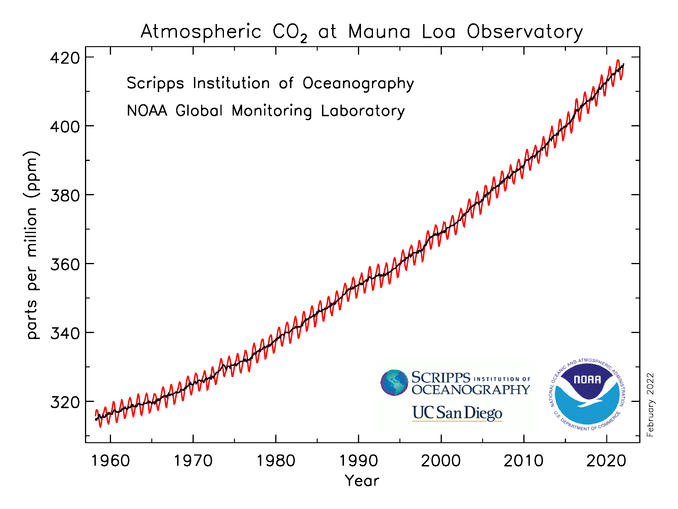
My conclusion: the greenhouse gases are indeed causing the earth to warm.
Natural or Human Causes?
This is the crucial question, and the answer is complex. Greenhouse gases are not new. There have been greenhouse gases from natural sources surrounding earth forever. They have kept the earth from being too cold for human life. Recently, though, the greenhouse gas concentrations have increased and the earth has warmed. It is appropriate to ask, and important to answer: Could the natural sources have increased enough to cause the warming, or is the warming due to human sources?
The chorus has been very active on this issue; there is a huge ‘consensus’ among the climate choir singers that humans, through burning fossil fuels and other actions, have caused the increase in greenhouse gases. For example, in its Fifth Assessment Report, the Intergovernmental Panel on Climate Change (IPCC), a group of 1,300 independent scientific experts from countries all over the world under the auspices of the United Nations, concluded there’s a “more than 95 percent probability that human activities over the past 50 years” have warmed our planet. That’s not data, that’s the chorus singing to the choir.
But then I found an honest-to-God research paper that directly addressed the question of natural versus human sources of greenhouse gases, and it had data and references! It is written by Yue Xi-Liu (yes, Chinese) and describes a study entitled ‘Contributions of natural systems and human activity to greenhouse gas emissions’. Exactly what I was looking for. I’ll summarize the papers results in the next few paragraphs.
The data show that, until recently, the earth has had a more or less ‘self-balancing’ carbon system. That is, greenhouse gas emissions from natural sources (forest fires, permafrost, volcanoes, and earthquakes) have been largely absorbed by natural carbon sinks (the ocean, forests, soils, and plants.)
Now, however, emissions from human sources (oil, coal, natural gas, and activities like deforestation, agriculture, and cement production) have increased, and are upsetting the balance. The amount of CO2 in the atmosphere now far exceeds the naturally occurring range seen during the last 650,000 years.
There are data to show that the natural sources of greenhouse gas have not grown significantly. What has grown is the amount of greenhouse gases emitted from burning coal, oil, and gas. Other climatic influences like volcanoes, the sun and natural variability cannot explain the timing and extent of the observed changes.
More data: another research scientist, Benjamin Cook at the NASA Goddard Institute for Space Studies, said “Only the greenhouse gas emissions from fossil fuels and industrialization gave us a prediction that lines up with the warming we’re seeing.”
Conclusion
So . . . oceans are indeed warming, contributing to the wild and weird weather, greenhouse gases are indeed increasing in the atmosphere, contributing to the warming, and the cause is very likely to be human activity. Convinced by the data, I changed from climate agnostic to believer. I now think we – the human race on Earth – have got to get serious and do significant things to reduce the generation of greenhouse gases. Else we will find ourselves in deep trouble.
More about the specifics of this in future articles. But it isn’t just a U.S. problem; the whole world (e.g., China, India, Russia, etc.) has to solve it. We’ll need a lot of good luck with that, right?
Just Sayin’.
 John R. Dixon